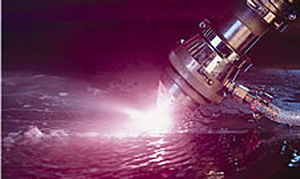
The processes of precision cutting surprisingly impact an immense range of industries. Without precision cutting methods, most original equipment manufacturers (or OEMs) would not be able to fabricate the products, or provide the services that help build everyday life.
Industries influenced by precision cutting include everything from artwork and sign building, to automotive and aerospace, to heating, ventilating and air conditioning (HVAC), to farming, energy, and mining.
What is Precision Cutting?
In regard to precision cutting, the material being cut is often some sort of steel, or alloy. There are several approaches to precision cutting. Three common types are:
-
Plasma Cutting
-
Laser Cutting
-
Waterjet Cutting
A variety of plasma cutters are available but fundamentally, all maintain the same method and design.
The technique of plasma cutting employs the scientific concepts behind electrochemistry. It begins with the use of an inert gas such as argon, nitrogen, oxygen, or hydrogen. At very high pressure points, this gas passes through a narrow path within the plasma nozzle.
At the centre of the nozzle is a negatively charged electrode. A circuit is created by powering the negative electrode and bringing the nozzle in contact with the metal being cut, producing a spark and turning the gas into plasma. This is referred to as a plasma arc or electrical arc.
At this point the plasma is so hot and is blown so quickly that it melts the metal it touches, "cutting” the material. Plasma temperatures can range from about 16,500 degrees Celsius (30,000 degrees Fahrenheit), to 25,000 degrees Celsius (45,000 degrees Fahrenheit).
In addition to the path for the electrode and plasma, the nozzle has two other pathways. These pathways send a continuous supply of what is called shielding gas to the perimeter of the flowing plasma. The purpose of the shielding gas is to:
Plasma torches can cut up to a thickness of about 6 inches (150 mm). For thinner materials, a trend toward laser cutting methods is being used.
Laser cutting is a type of computer numerical controlled (CNC) cutting. All types of laser cut devices essentially operate the same way. A gas laser acts as the energy source, located within the device. As it becomes energized, a laser beam is directed by mirrors inside of the machine. A lens then directs the light to the work area, outside of the device.
Waterjet cutting is another common CNC approach to precision metal cutting.
In a waterjet cutter, a highly pressurized stream of water is used to cut through materials such as:
-
Inconel
-
Aluminium
-
Tool steel
-
Stainless steel
-
Titanium
Pure water can be used in the cutters, or a mixture with an abrasive substance like garnet or aluminium oxide may also be employed in what is called abrasive waterjet cutters.
Water pressures can range from 20,000 to 50,000 pounds per square inch (psi) and can cut densities anywhere from five-thousandths of an inch to 7 inches.
Each precision cutting method encompasses several advantages. For instance, laser cutting is considered to more precise than plasma cutting. However, the plasma cutting technique is better suited to cut through greater thicknesses. And while the heat affected zone (HAZ) is minimal in plasma cutters and laser cutters, waterjet cutters have a zero possibility of HAZ, resulting in no unwanted warping of the material. There are pros and cons to each method, all of which are dependent upon the type of material that needs to be cut, and the type of cut required.